Welcome to Mountain Edibles

I have been wandering the mountains of Utah as an amateur botanist for many years, and I am now trying to share some of what I have learned with those around me. I am a user of many edible and medicinal plants, and I believe the edible plants are the least known area of my expertise. This blog is a way to increase the popular knowledge of edible plants.

I also do plant walks to teach about edible and medicinal plants in person. If you are in the Northern Utah area, and are interested in arranging such a presentation, you can contact me using the contact form at the bottom of the page.

Thank you for coming.

Wednesday, June 18, 2014

Urtica dioica

Urtica dioica
Urtica Dioica
Perhaps the most infamous wild edible is stinging nettle, at least to those who have not tried it. Yes, you should use proper care when harvesting nettle: gloves, long pants, and stay aware of where the plants are around you. The mature stems are an excellent source of tough fibers for rope and blankets, so when picking for food, you just want to pick off the top 2 or 3 sets of leaves, preferably from younger plants. Stinging nettle tends to grow in large colonies when it is found, so even just a few leaves from each plant quickly adds up to a large amount.

When identifying stinging nettle, remember that it looks a lot like mint, with the square stem and opposite leaves. When it is mature it can easily be distinguished from mints by the flowers. Mint flowers are showy and grow in dense clusters at the top of the stem or in the axils of the leaves. Nettle flowers are inconspicuous but you will see the long drooping seed stalks which grow from the upper leaf axils and hang down. When young, look for the stinging hairs, which are especially prominent on the stem, and also noticeable on the leaves if you look closely. Actually stinging yourself is also a sure-fire method of identification, and isn't too bad when you can choose the location and amount of sting.

I washed my nettle, turning the bunch with a large grilling fork, and then boiled it for 10 minutes, saving the water, since nettle tea is renowned for its healthy effects. The drained and cooled nettle leaves were very soft and rather slimy. The flavor is decent, and grows on you after a few bites, but the sliminess gets in the way of enjoying the flavor. The nettle tea is a bit thickened and has a hearty flavor. My wife suggested that it would make an really good soup broth. And so it turns out that nettle's true culinary calling is to be soup. I cooked potatoes, carrots, onion, salt, pepper, and parsley and chives from my yard, along with the nettle tea and nettle leaves, and had a very good nettle/vegetable soup. The nettle flavor takes a few bites to get used to, but the more you eat it, the more you like it.

Hot & Sour Nettle Soup

The taste of the nettle soup reminded me a bit of chinese hot and sour soup, so the next time I picked stinging nettle, I made hot & sour nettle soup. The nettles are not slimy if they are only cooked 1-3 minutes, so I cooked them about 2 minutes, and then after they were safe to handle, I separated the larger stems and leaves and cooked them another 10 minutes to make the nettle broth. Then I discarded those nettles and added back in the nettles which had been cooked less. Besides the nettle leaves, I added some foraged vegetables: cooked dock leaves, wild onions, water leaf root (cooked) and stem. (Day lilies do not grow wild here, but they are a traditional ingredient as well.) From my garden came scallions, daikon, and egg drop. From the store I added mushrooms, black fungus, and carrots. The broth was enhanced to get the hot & sour flavor with soy sauce, pepper, and rice vinegar (never use white vinegar; it's more of a cleaning chemical and is not fit for human consumption).

Sunday, June 1, 2014

Claytonia perfoliata

Claytonia perfoliata
One of the most widely known edible greens is Miner's Lettuce. Famous for being used by California Gold Rush miner's to keep from getting scurvy, it is high in vitamin C and also protein. The latin name is either Claytonia perfoliata or Montia perfoliata, depending on the botanist and whether they care that this plant has fibrous roots, which along with the leaf shape distinguishes this plant from its cousin, Claytonia lanceolata, which has an edible tuberous root.

It is easy to recognize from the nearly round leaf with the stem going through the center and displaying small white flowers above or cradled in the leaf. Botanists actually consider this a pair of opposite leaves which have joined on both sides to completely wrap around the stem. There are also basal leaves without flowering stems, which are half-circle shaped with any corners rounded off.

Except for the small, fibrous roots, the entire plant is edible. The leaves, flowers and stems all taste mild and tender, although some of the older plants may have a tinge of bitterness. A good plant may have ten to twenty stems and leaves. It pulls away from the ground easily, and after discarding the root and any of the lowest leaves that are shriveled or dirty, the entire plant can be eaten. Instant salad! 

Miner's Lettuce is fresh flavored and crisp, and makes an excellent base leaf for a spring salad. Each plant has many leaves, so it is easy to collect enough for a large salad. the stems also taste good, so there is no need to try to discard them. Then you can add whatever other greens are around to give some additional flavor and variety. Onion flowers are one of my favorite additions, but you can also add violet leaves and flowers, spring beauty, glacier lily leaves, young false solomons seal leaves and flower buds, sweet cicely, etc, etc, etc.

Saturday, May 31, 2014

Cardamine cordifolia

Cardamine cordifolia

This is known by the common name of Heartleaf Bittercress, which is a bit of a misnomer, since the flavor of the leaves is more hot than bitter. In fact they taste just like horseradish! I happen to like horseradish a lot, so I really enjoyed finding these leaves, and they make a good addition to sandwiches.

I have always found this plant in or beside shallow mountain streams. The leaf shape is vaguely heart-shaped, but with several lobes breaking up the heart's outline. One distinctive feature of this plant is that the main veins of the leaf go all the way to the tips of the lobes, where (looking in a microscope) they project slightly as enlarged glands. These glands appear to the unaided eye as white dots at the tips of the lobes.

I have tried cooking the leaves. After about 5 minutes they were quite bitter, but after 10-15 minutes (at 10,000 feet elevation; your times may vary) they were much better tasting. There was still a hint of bitterness, but it was more of an exotic flavor, and I enjoyed eating them. The bitterness comes out in the water, so you need to throw out the water afterwards. Cooking in one change of water would work well, but adding directly to a stew without pre-cooking would be a very bad thing to do. The stems are very tough and do not soften with cooking.

Sunday, May 18, 2014

Viola species

Viola nuttallii
Viola nuttallii
Violets are a common flower in the spring. In our mountains there are several species which are very common including Viola purpurea (yellow), Viola nuttallii (yellow with oval leaves), Viola adunca (blue), Viola canadensis (white), and Viola papilionacea (purple). It's not very important which species you find. The constant need for new botanical publications from academia has made this one of the genuses which has been nit-picked beyond any useful purpose.

The leaves and flowers are usually eaten raw in salads. The flowers taste good, and the spur on the back of the flower is a container for nectar, which gives the flowers their sweetness. The leaves are not quite a good as the flowers; they taste good, but are a little tough. 

The leaves are said to thicken soups "like okra". If you are not a gumbo veteran, that means they thicken the soup by giving it a mucilaginous (slimy) quality. The leaves themselves become quite mucilaginous when cooked. When raw, the mucilaginous quality is somewhat noticeable as you chew them up, especially if you are looking for it. This can be helpful for soothing your throat, and I have chewed violet leaves to remove the burny sensation after eating many glacier lilies or evening primroses.

Saturday, May 10, 2014

Erythronium grandiflorum

Erythronium grandiflorum
Erythronium grandiflorum, often called Glacier Lily, is a beautiful yellow drooping lily which blooms early in the spring for a short time, and soon dies down to spend the rest of the year waiting for the next snowmelt. If you find it at the right time and place it will be growing so abundantly and thickly that one cannot walk through them without stepping on some. Fortunately for us, the correct time moves slowly up the mountains, so in the spring it is more a matter of finding the right elevation than the right time.

Samuel Thayer, in his book, Forager's Harvest, speaks very highly of the eastern species, Erythronium americanum or Trout Lily, and mentions that our western Glacier Lily is also good and has a larger bulb. I thought the bulbs were still quite small, and they are several inches deep and rather difficult to dig up. After digging up several specimens, both before and during flowering, I found that the bulbs were sweetest while the flower was in bloom, which is good news for finding them at the right stage at least. They are crisp and quite sweet in bloom, but the difficulty of digging them up discourages me from wanting to seek them out.

The leaves, however, are quite easy to pick and are a very good raw salad leaf. They have a succulent flavor, and are certainly worth the effort of picking. Because these lilies only grow two leaves, picking them is going to be almost as traumatic to the plant as digging it up entirely, so be sure to harvest from an area where they grow so abundantly that your guilt is not tripped.

Below is a picture of several roots I dug up. The outer brown coating is easy to rub off, leaving the edible white root fairly clean. The white part of the stem gives an indication of how deep each one was. The stem, like the leaves and root, is edible, and gets sweeter the closer you get to the root.

roots

After the flower fades, it produces a seed pod, which you can learn to recognize after some experience with the plant. This is also edible. It is fairly crunchy and good tasting, comparible with garden peas.

Eating several of the whole plants or seed pods will eventually produce a slight burny sensation is the back of the throat. Some people can detect it sooner but it takes more than three for me. I have not yet tried cooking them to see if that reduces it, but the demulcence of a violet leaf helps to remove that feeling.

Wednesday, May 7, 2014

Claytonia lanceolata

Claytonia lanceolata
I came across the first few blooms of Spring Beauty (Claytonia lanceolata) while foraging for Indian Potato, which starts blooming even earlier in the spring. They are a close relative of Miner's Lettuce (Claytonia perfoliata), so I dug a few up to try out. Later I stumbled on a few additional bulbs while digging Indian Potato. The Spring Beauty bulbs were easily recognized, even though they had not produced flowers yet, by the smooth surface and the way the stem starts very thin and white at the root, widening slightly and becoming red before turning green toward the leaf.

The flowers of Spring Beauty deserve the name, bright white or sometimes pinkish with yellow spots at the base of the petals and pink anthers at the ends of the stamens. If you look closely, you can notice a relatively unusual feature of only a few families of flowers; the stamens grow opposite the petals instead of alternate with them. That means the stamens grow from the center point of the petals, instead from the center of the spaces between the petals, as in most flowers. There are usually a few nodding buds waiting their turn to open. It is a small plant, usually only 2-3 inches tall, and the few leaves (usually just one pair) are opposite. I observed a wide range of leaf shapes, with lanceolate (long and tapering at both ends) being most common, but some plants had nearly round leaves. Most roots are quite small, about pea-sized, and have a smooth coating. There are often two or more stems growing from a single root. If you find a good area with lots of Spring Beauties, look for clusters of plants. The larger roots will put up numerous stems, which will emerge from the ground within a few inches of each other at the surface. A large root with 10 or more stems may be an inch across. A good practice would be to look for these larger plants, and put back any pea-sized roots you dig up.

The leaves are very good raw, and in my opinion taste even better than Miner's Lettuce. The leaves are pleasant and slightly thicker and juicier than store-style lettuce, while the stem and flowers have a stronger flavor, with a little kick of spiciness. You will have plenty of these if you have found some larger roots, so an easy way to enjoy the leaves alone is to pinch off the flower cluster, and then bite the pair of leaves off the stem. Or eat it with the flowers and stem to enjoy their spicy kick. Just like Miner's Lettuce, these leaves are high in vitamins C and A.

The roots are best boiled about 5 minutes. After 10 minutes they seemed rather mushy. They have a definite flavor of their own, reminiscent of cooked cauliflower, but stronger, and they sometimes have a curiously pungent after-aroma. But with some salt, pepper, and your favorite variety of grease, they are quite yummy.

(2015 update)
I'm getting better at finding the larger roots this year. The root will send up multiple stems, which spread out and emerge from the soil separately, looking like individual plants. Small roots will only send up one or two stems, so if you see a single spring beauty, you can expect a small root to be under it. The trick is to look for clusters of spring beauties, or better yet, a circle of them. Dig under those, and you can expect to find a nice sized root, about an inch or so across. The picture below is a good example of a large root, with a whole salad growing up out of it.

large root


Sunday, May 4, 2014

Hydrophyllum capitatum

Hydrophyllum capitatum
I saw a lot of one particularly interesting distinctive leaf growing on my early spring outings. Lower down the mountain, I was able to find them again in a more developed state: Hydrophyllum capitatum or ballhead waterleaf. The excellent Wild Harvests blog reported some success with this and a related pacific waterleaf (H.tenuipes), so this plant became a goal for the following hikes.

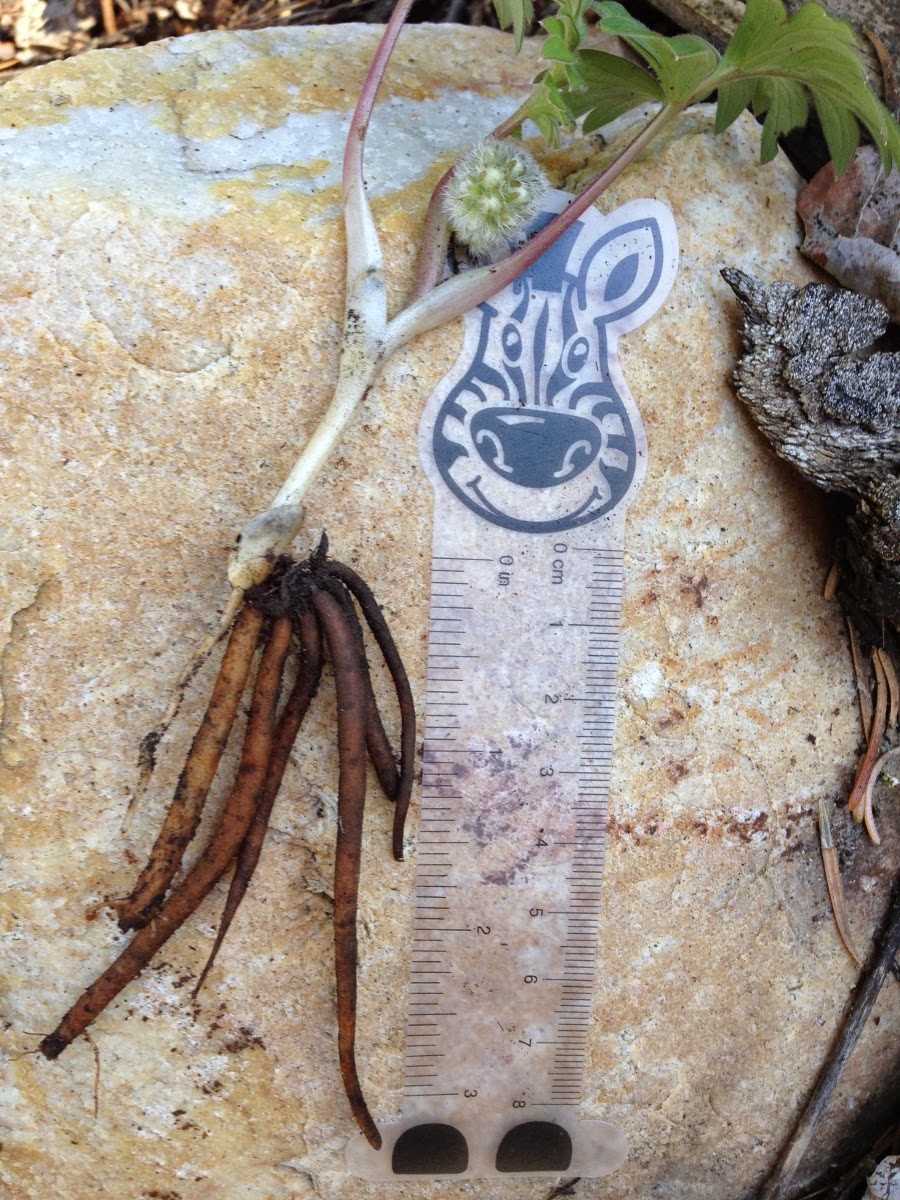
The deeply pinnately lobed leaves have a very distinctive shape and are slightly soft-furry, just enough to be annoying to the tongue when raw. Delphinium leaves are also deeply lobed, and emerging at the same time in my area, but all the lobes are radiating from one point (palmately lobed) instead of coming from both sides of a central vein (pinnately lobed). To be sure about the identification, wait until the "ballhead" round clusters of flower buds appear. In H. capitatum they stay below the leaves, while in H. occidentale they rise above the leaves. These will eventually turn into a cluster of purplish-white flowers with protruding stamens giving it a frilly appearance. Below ground is a cluster of brownish roots, each about the size of a bean sprout.

After boiling for 5 minutes, as suggested by the above blog, the leaves where soft and spinachy, and the stem, which the wild harvests blog spoke highly of, were tasty and still slightly crisp. (They leaves seem best after about 3 minutes of boiling.) The immature flower clusters can be eaten along with the leaves.

The root was still rather tough after boiling 5 minutes, so I put the roots back in the boiling water for another 15 minutes. (15 minutes boiling is enough, even at my altitude.) After that time the roots had become much more tender, and tasted quite good, either plain, or with some oil and salt to enhance the flavor. The flavor is very much like potatoes, although the shape is very different.

The best part for eating raw is the lowest portion of the stem, between the root and the flower-head. This part is white and often underground. It is juicy and crunchy, but becomes bitter higher up where the stem takes on more color.

You can make a hearty 3-course meal from waterleaf alone. First, separate the roots, and break each root from the others to make cleaning easier. Clean and boil for 15 minutes, then serve with butter, salt, and pepper to enhance their potato-like flavor. Second, separate and wash the leaves, then boil for 3 minutes. They will wilt and lose much of the space they occupied while raw. Serve like cooked spinach. The younger unopened flower clusters can also be boiled with the leaves, and taste similar. Third, take the lower, lighter colored portion of the stem, and serve either raw or boiled for 3 minutes. It still retains some of its crispness after the brief boiling. I usually discard the upper stems and opened flower clusters, but you can experiment with them for yourself if you want.

Below is a picture of the roots. Notice the new white root is directly under the plant, and the large mature roots are off to the side. This makes me suspect it forms a new root each year.

roots